Life's twists lead on. Leslie sent me links to her winter beeches, a motif I've obsessed over, and to Sean O'Hagen's Guardian piece about long-time favorite Robert Adams, pushing a button unknowingly. Her rhythmical trunks and pale, twisted leaves, and Adams' B&W ways of conveying connections to place connected with me, Nehalem Bay State Park, from This Day, 2009 especially. I revisited recent images made after another unexpected turn.
Expecting to hike in Shenandoah NPA two weeks ago, I pulled into the shopping center meeting place by 8:00 - and found no hikers. Wondering what happened and what to do, I returned to this fallen beech. This accident, the grey winter woods, the tatooed beech body, the silvered day, Leslie Kiefer, Sean O'Hagen and Robert Adams all conspired unwittingly to cause a color photographer go grey.
Series have become my method.
Monday, February 20, 2012
Saturday, February 18, 2012
Thorofare Mtn. Bushwhack
Friday, February 17, 2012
Mt. St. Alban - Indoors on a Wet Winter Day
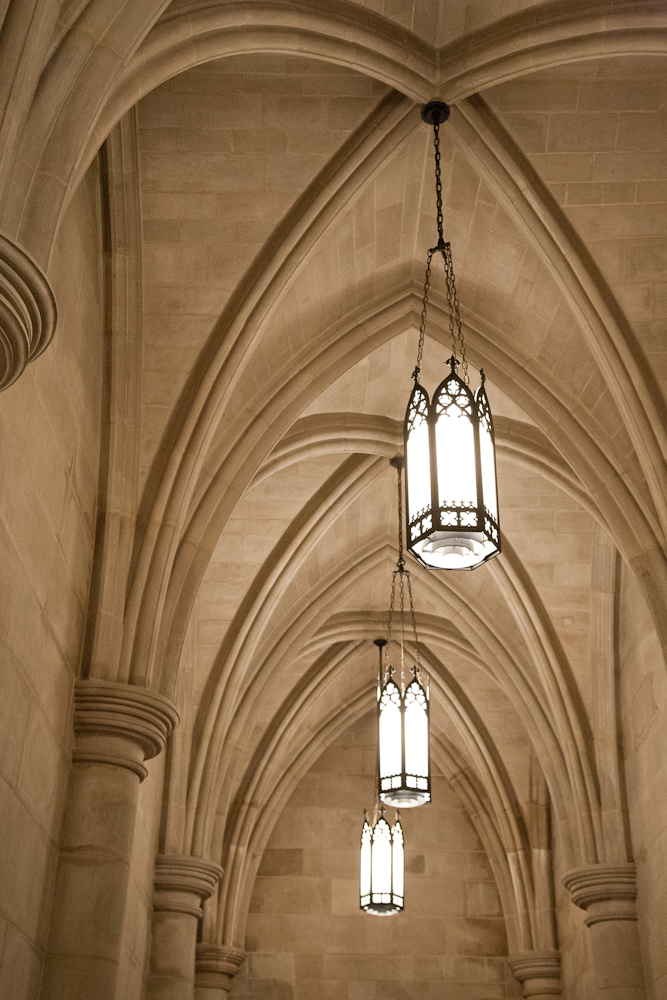
Starting below ground and ascending above Washington's highest height, the Nat Cat and surrounding Olmsted-designed gardens and grounds create a restorative haunt. Inside and out, sumptuous design and craftsmanship blend elements of light and flora in Gothic motifs and tracery. Forbidden recesses and soaring spaces express hierarchies in darkness and light, low and high. I find the place as provocative as it is evocative. Ever photo-friendly after all these years, tripods are still permitted.
Monday, January 23, 2012
High on Life - Driving 100 miles one way to hike 10
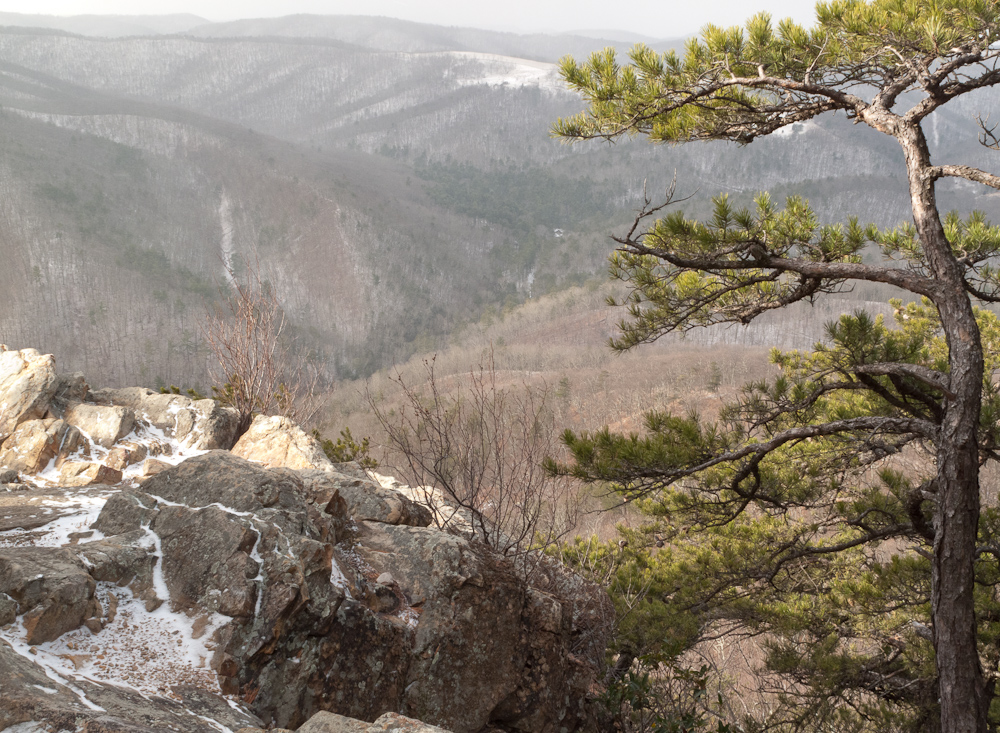
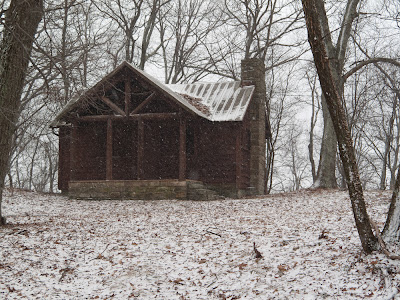
Of the many offerings for WDC area hikers last week, I jumped on one to West Virginia's Lost River SP, part of the roads-less-traveled-at-least-by mid-week-hikers series. Discovering Cranny Crow and Big Ridge trails was not to be missed, as WV's protected places put me in the state I seek.
The ratio of miles-driven to miles-walked, something I hear other hikers mention, made me curious to know how much carbon emission the hike generated. Indeed other mid-week hikers opted for a closer-in hike with a more balanced ratio. Googling has its own footprint, I note while finding this information is not so easy to come by.
After some looking I find: "In Europe, the two standard measuring cycles for "litre/100 km" value are "urban" traffic with speeds up to 50 km/h from a cold start, and then "extra urban" travel at various speeds up to 120 km/h which follows the urban test. A combined figure is also quoted showing the total fuel consumed in divided by the total distance traveled in both tests. A reasonably modern European supermini and many mid-size cars, including station wagons, may manage motorway travel at 5 L/100 km (47 mpg US/56 mpg imp) or 6.5 L/100 km in city traffic (36 mpg US/43 mpg imp), with carbon dioxide emissions of around 140 g/km.," supplied at Wiki.
To run the risk of bizarre understatement, many factors complicate the calculation to determine atmospheric carbon dioxide emitted on any particular car trip. However, using above figures with respect to a Toyota Land Cruiser, assuming 15.66 mpg (1/3 of 47 mpg) and thus 3 times the emission rate, emission might be something on the order of 420 gms / km, or .93 pounds / 62 miles. I come up with about 3 pounds of carbon emissions and 13.6 gallons of gas consumed.
I don't know the average fuel economy of our "fleet" of five or so cars carrying around 15 hikers, or the total miles individuals drove to carpooling spots...etc. (But at a rate of $12. per each of 3 occupants, it turns out the driver of this car is not adequately compensated for gas. Again, complements to the driver, with renewed appreciation.) This all presents another picture, somewhat unclear, to ponder. It comes from, somewhat nerdily, seeking balance, and questioning impacts and implications of achieving a certain state, in good company. Searching for snow.
The ratio of miles-driven to miles-walked, something I hear other hikers mention, made me curious to know how much carbon emission the hike generated. Indeed other mid-week hikers opted for a closer-in hike with a more balanced ratio. Googling has its own footprint, I note while finding this information is not so easy to come by.After some looking I find: "In Europe, the two standard measuring cycles for "litre/100 km" value are "urban" traffic with speeds up to 50 km/h from a cold start, and then "extra urban" travel at various speeds up to 120 km/h which follows the urban test. A combined figure is also quoted showing the total fuel consumed in divided by the total distance traveled in both tests. A reasonably modern European supermini and many mid-size cars, including station wagons, may manage motorway travel at 5 L/100 km (47 mpg US/56 mpg imp) or 6.5 L/100 km in city traffic (36 mpg US/43 mpg imp), with carbon dioxide emissions of around 140 g/km.," supplied at Wiki.
To run the risk of bizarre understatement, many factors complicate the calculation to determine atmospheric carbon dioxide emitted on any particular car trip. However, using above figures with respect to a Toyota Land Cruiser, assuming 15.66 mpg (1/3 of 47 mpg) and thus 3 times the emission rate, emission might be something on the order of 420 gms / km, or .93 pounds / 62 miles. I come up with about 3 pounds of carbon emissions and 13.6 gallons of gas consumed.
I don't know the average fuel economy of our "fleet" of five or so cars carrying around 15 hikers, or the total miles individuals drove to carpooling spots...etc. (But at a rate of $12. per each of 3 occupants, it turns out the driver of this car is not adequately compensated for gas. Again, complements to the driver, with renewed appreciation.) This all presents another picture, somewhat unclear, to ponder. It comes from, somewhat nerdily, seeking balance, and questioning impacts and implications of achieving a certain state, in good company. Searching for snow.
Labels:
carbon footprint,
hiking,
Lost River,
West Virginia
Tuesday, January 17, 2012
A (Sometimes) 1 Percenter Casts a Gaze at WOC
Where ever water's refreshment is sought, White Oak Canyon remains a primal place to see and smell water's essence on a clean cold day. Feeling pallid and cooped up, though not especially winter-blasted, now that the thermometer often belies the cold season, the gorge delivers a better-calibrated hit of goodness than an oxygen bar. Revival is startling.
Reading William Cronin's provocative introduction to Uncommon Ground - Rethinking the Human Place in Nature, by 15 authors who convened at UC Irvine to "explore contemporary environmental problems from a broadly humanistic interdisciplinary perspective" coincided with this visit. At any rate, trying to snag shots and maintain the pace of 7 hiking companions, I began thinking of ice as one more diminishing resource, one that, I for one, in my small way, do my part to rarefy. I wonder if a week of sub-freezing weather will occur this decade to convert White Oak Canyon's six falls to massive, scalable ice formations, as the hike leader depicted in images made in the two preceding decades.
The steep rocky path, partially concreted with embedded cobbles, reminds me White Oak Canyon was the principle attraction of segregated Skyland resort before becoming a classic hike in Shenandoah National Park. Enjoyment of SNP recalls 500 families unhappily removed to create the park, many descended from settlers following on the heels of vanquished natives, some in turn, we are reminded, who did some vanquishing of their own.
After editing images last night I read The Week citing CNN.com, "To be counted among the world's richest 1 percent, a single individual has to earn just $34,000 a year. Members of the planet's true middle class, meanwhile, live on just $1,225 a year." That's a picture.
Reading William Cronin's provocative introduction to Uncommon Ground - Rethinking the Human Place in Nature, by 15 authors who convened at UC Irvine to "explore contemporary environmental problems from a broadly humanistic interdisciplinary perspective" coincided with this visit. At any rate, trying to snag shots and maintain the pace of 7 hiking companions, I began thinking of ice as one more diminishing resource, one that, I for one, in my small way, do my part to rarefy. I wonder if a week of sub-freezing weather will occur this decade to convert White Oak Canyon's six falls to massive, scalable ice formations, as the hike leader depicted in images made in the two preceding decades.
The steep rocky path, partially concreted with embedded cobbles, reminds me White Oak Canyon was the principle attraction of segregated Skyland resort before becoming a classic hike in Shenandoah National Park. Enjoyment of SNP recalls 500 families unhappily removed to create the park, many descended from settlers following on the heels of vanquished natives, some in turn, we are reminded, who did some vanquishing of their own.
After editing images last night I read The Week citing CNN.com, "To be counted among the world's richest 1 percent, a single individual has to earn just $34,000 a year. Members of the planet's true middle class, meanwhile, live on just $1,225 a year." That's a picture.
Friday, December 30, 2011
Limit of Disturbance at the Odor Control Site - Orwellian Tang
Stakes marked l.o.d. surround the work zone at one of six new facilities contracted by the Water and Sewer Authority to vacuum and charcoal-filter malodorous air emanating from the Potomac Interceptor, a 50 mile long gravity sewer on national and regional park properties in Maryland, DC and VA leading to Blue Plains treatment plant. Slated for completion by November 2011by WASA, the Angler's site is still under construction, apparently on holiday break 12/29/11.
The construction schedule allowed "sufficient time to reproduce a[n unnamed] rare, endangered and threatened plant that is located" at one site. I wonder which plant and hope it worked out.
Perhaps this scheme is a good one, but in the mean time visual disturbance assaults the senses like air wafting humidly, putridly and incongrously from vents in the woods. The new building, designed to look like a lockhouse, and the $3.36 million repair to the 2008 canal breach associated with Hurricane Hannah form a continuous construction site. More trees appear doomed with orange x's.
Beyond the unsettling limits of disturbance, a visit to trees and rocks photographed before in search of green.
No thrilling images here, just change and what remains on a visit to an old same place.
The construction schedule allowed "sufficient time to reproduce a[n unnamed] rare, endangered and threatened plant that is located" at one site. I wonder which plant and hope it worked out.
Perhaps this scheme is a good one, but in the mean time visual disturbance assaults the senses like air wafting humidly, putridly and incongrously from vents in the woods. The new building, designed to look like a lockhouse, and the $3.36 million repair to the 2008 canal breach associated with Hurricane Hannah form a continuous construction site. More trees appear doomed with orange x's.
Beyond the unsettling limits of disturbance, a visit to trees and rocks photographed before in search of green.
No thrilling images here, just change and what remains on a visit to an old same place.
Subscribe to:
Posts (Atom)